
By Matthew DeBord
HQ 78 | SUMMER 2012
When you look at wine in America, it’s easy to think that it’s all about California. That’s not surprising, as the Golden State not only dominates winemaking in the U.S. but also holds its own quite capably against international rivals. The only two other countries that can really match it are France, for quality, and Australia, for quantity. Everything about California sets up for viticultural near-perfection: the state is vast and has numerous “microclimates,” whose distinctive conditions of soil and weather produce a vast array of different grapes; the winemaking talent is sophisticated and risk-taking; and there’s a huge swath of less-than-stunning vineyards that nevertheless yield good enough fruit to support a massive bulk-wine business.
However, America’s a big place. There’s room for more than California’s perfection and bounty, believe it or not. And you need to look no further than the state’s two closest northern neighbors, Washington and Oregon.
If the 1970s and 1980s told the story of the ascent of the California wine industry, then the 1990s and early 2000s have told the tale of Washington and Oregon. But the winemaking cultures of these two upstarts are individually unique. California has it all, while Washington has focus and Oregon has, for lack of a better term, a kind of countercultural hippie snobbery going for it – as well as great wines.
California of course makes everything when it comes to wine; the state’s international fame rests on big-name Cabernet Sauvignon and Chardonnay, but you can find everything from Sangiovese to Tempranillo (a couple of European grapes) on the menu.
Washington, on the other hand, is better known simply for Cabernet and Merlot. And not just any Cabernet and Merlot, but Cabernet and Merlot in a more refined and sophisticated European style. California’s best Cabs are full-bore, while Washington’s blended Cab/Merlots are restrained.
Ironically, some California winemakers have moved toward this style in recent years, perhaps because they’re embarrassed by the riches that their home state provides in such abundance. Regardless, Washington has come on strong over the past decade or so. For white wines, Washington is famous for its Rieslings, but it does other whites as well, again in a more European manner than California. The biggest winemaking name in the state is Chateau Ste. Michelle, whose wines are distributed nationally and easy to find, usually at very nice prices compared to wines from California.
Washington does have a bit of an image problem, in that it’s usually talked about as being a smaller or quirkier version of California. Personally, I don’t think that’s entirely fair. Its higher-end reds are different enough from California’s to provide the state with its own identity. As
I said, you can easily find Chateau Ste. Michelle bottlings, but a winery worth seeking out is L’Ecole No. 41, which produces a nice range of wines. If you want to go nuts, then track down Quilceda Creek, whose wines are expensive but beloved by the critics, and deservedly so.
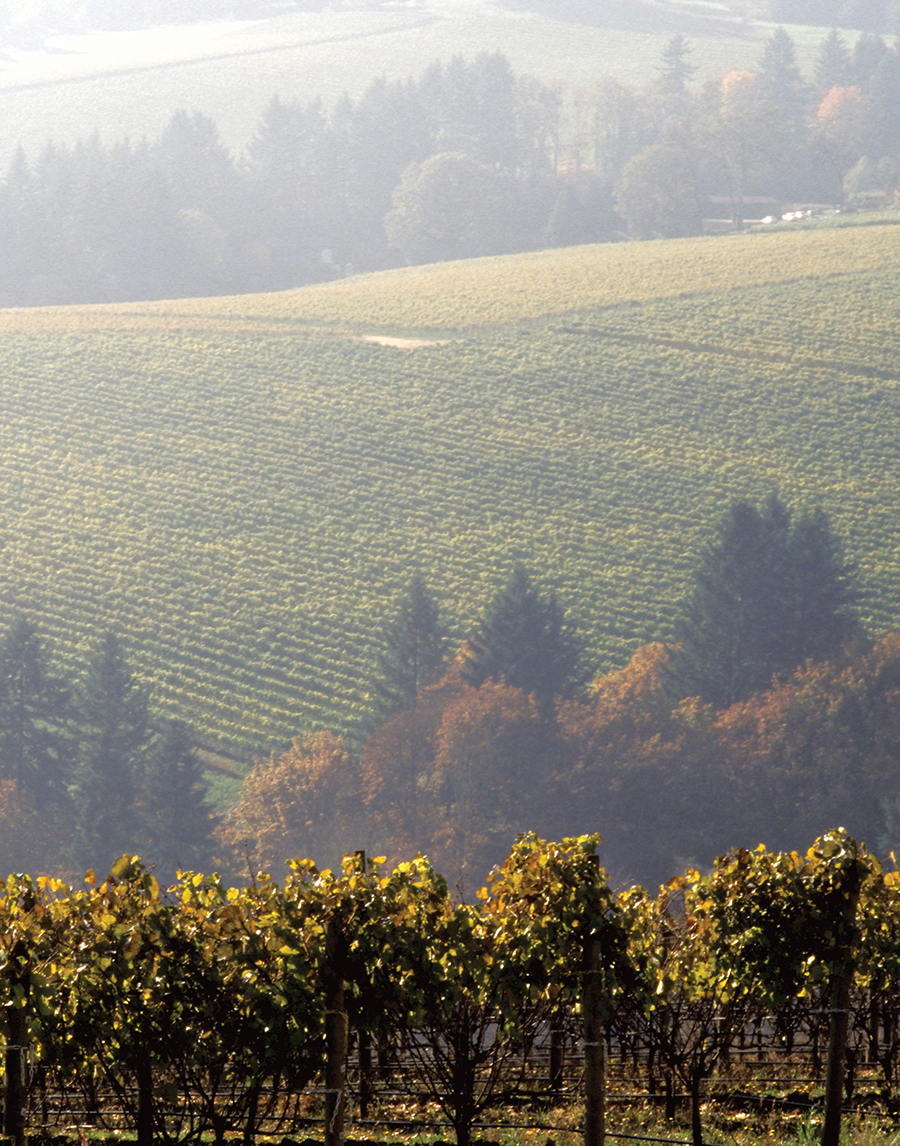
If Washington is a bit tough to really get to know, Oregon is the opposite. It’s the anti-California. There’s a long history of people getting sick of the Golden State (for whatever reason) and moving up to Oregon to get away from the “Californication.” As such, the state’s wine industry is a realm of rebels, dreamers and dissidents. Naturally, the name-brand grapes of California – Cabernet and Merlot – don’t hold sway. It’s Pinot Noir, that most tricky and esoteric of red grapes, that rules in Oregon.
The remarkable thing is that in a very short period of time – Oregon’s serious wine industry is only about 30 years old – Oregon has distinguished itself as the only other place in the world outside the Burgundy region of France where Pinot Noir really tastes, according to many, like it’s supposed to. Delicate yet powerful. Light yet rich. That’s Pinot Noir in a nutshell. It’s supposed to be a bundle of contradictions, somehow miraculously reconciled in the bottle. California hasn’t been able to achieve this trick; Pinots there are delicious, but they’re far away from the Burgundian model. The finesse is lacking. You could say that they’re sort of like a burly football player in a dress.
Not so in Oregon, where even the Burgundians have taken note, setting up satellite winemaking operations to test out this strange, wild region in the Pacific Northwest, which used to be noted for its communes and abundance of citizens who were utterly uninterested in, you know, retirement plans, business plans, making money or really capitalism in any form. You can actually see the successful Oregon Pinot Noir phenomenon as a protest against the “big wine business” of California to the south.
And what a protest! There are wine lovers who believe that America produces basically two great wines: Cabernet from the Napa Valley and Pinot Noir from Oregon. They have a case. Oregon producers such as Chehalem, Ponzi, and Torii Mor – who are well known now but were not 10 years ago – produce beautiful Pinots that dazzle with this subtle power. These aren’t big ol’ honking Cali Cabs, so if that’s your thing, you may not care for the Oregon Pinot style. But you at least owe it to yourself to give ’em a try.
A name I like and that’s relatively easy to find is Benton Lane, which is located in the Willamette Valley. The winery was started in 1988, so its success has come almost entirely in the past few decades. The wines are easy to spot: the label sports a distinctive “postage stamp” label. The Pinots range in price, so you can find something that fits your wallet.
American wine is more than California. And when it comes to Washington and Oregon, you get a wonderful chance to sample how two different states have taken different approaches to saying how much more than California they are.