
A century after it was founded, the W. Page Pitt School of Journalism & Mass Communications at Marshall University is still writing its story.
By Baylee Parsons
HQ 135 | AUTUMN 2026
In 1926, five students took a chance on a young professor in Marshall University’s first-ever journalism class.
Today, the W. Page Pitt School of Journalism & Mass Communications thrives with a full curriculum, career-ready graduates and new leadership at the helm.
As excitement buzzes around the department’s centennial anniversary this year, many are not only looking toward the program’s future but also reflecting on its humble beginnings.
One hundred years ago, William Page Pitt arrived at Marshall College as the first instructor of journalism, then part of the English department. A native New Yorker who was raised in West Virginia and found a love for journalism in Ohio, the young professor began his teaching career only one year after receiving his bachelor’s degree from Muskingum College.
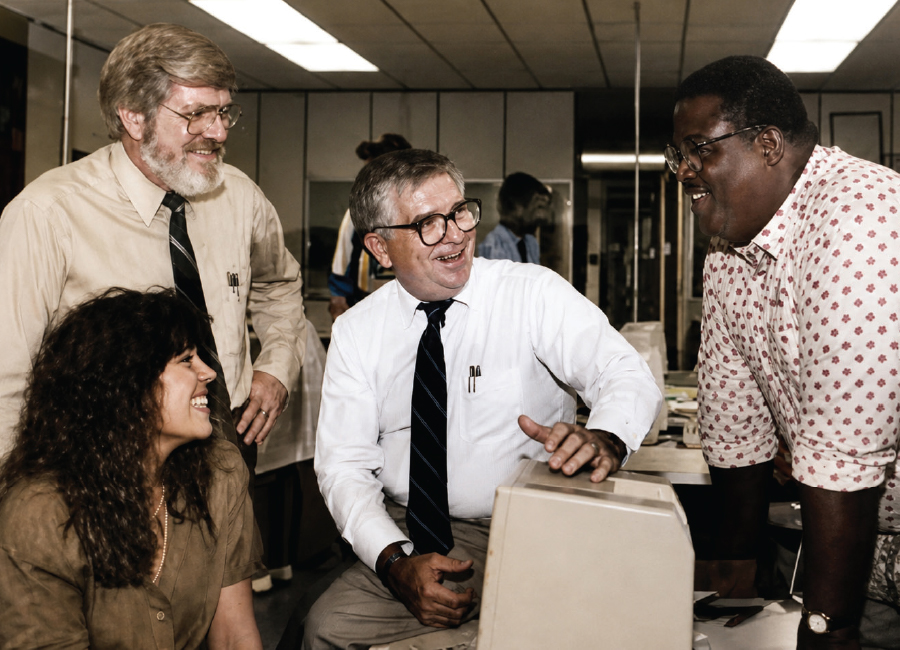
Over the next 44 years, journalism would grow from one feature writing class to a flourishing department — a feat Professor Emeritus George Arnold said would not have been possible without Pitt’s leadership.
“He had a larger-than-life personality — great conversationalist — and he was a very powerful person on campus,” Arnold said. “I think it’s one of the reasons that journalism did as well as it did in those days.”
Arnold, a faculty member from 1968 to 2004, witnessed the evolution of technologies available to journalists, which the school consistently replicated for its students. From manual typewriters to state-of-the-art computers, Arnold said the tools may have changed, but the faculty’s dedication to its students remained the same.
Pitt, for instance, never hesitated to help a student in financial need by collecting donations from the community.
“I said, ‘What is your philosophy, professor?’” Arnold said. “And he said, ‘George, you never know when $200 is going to make a difference between whether a student graduates or not.’”
The commitment of Pitt and other faculty members to their students is evident in the success of alumni highlighted in the school’s Hall of Fame, such as comedian and actor Soupy Sales, Pulitzer Prize winner John Hackworth, former New York Times editor Angela Dodson and U.S. News & World Report editor Marvin Stone.
Although Pitt retired in 1971, the legacy of the “Grand Old Man of Journalism” — as he was lovingly nicknamed on campus — continues through the university’s dedication of the school in his name in 1980.
Now, with the school under the leadership of Director Rob Quicke, Pitt’s mission remains more prevalent than ever.
“There’s this quote, I walk past it every day, by W. Page Pitt on the wall: ‘You’re not here to learn mediocrity, you’re here to learn excellence,’” said Quicke, a native of Blackburn, England, with two degrees from the University of Oxford. “I take that very, very seriously.”
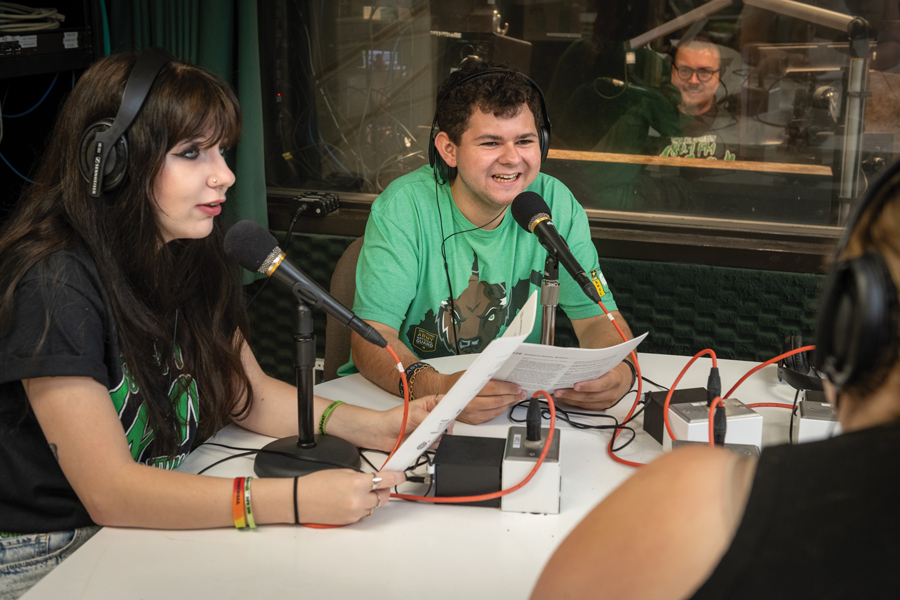
With leadership experience at multiple universities and a start in radio, Quicke took an interest in Marshall after connecting with Chuck Bailey, professor and faculty manager of WMUL-FM, over the radio station’s award-winning reputation.
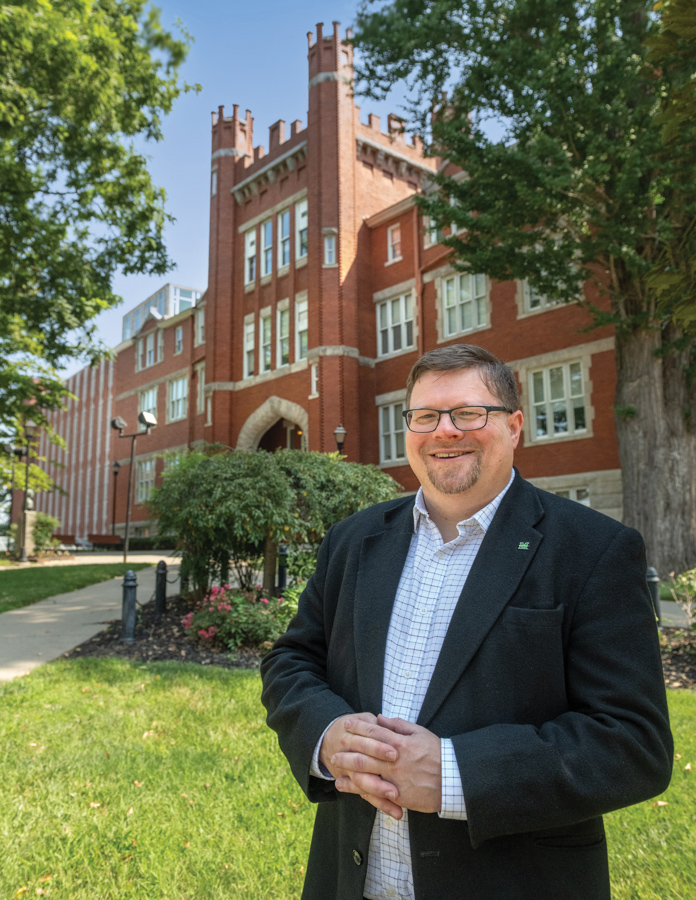
When Quicke learned of the journalism school’s nearly 100-year-old history, he saw an opportunity to build upon its legacy.
“I was really excited about the possibility of coming here just so I could be but a chapter in the larger story of what has been going on the last century,” Quicke said.
Having begun his tenure as director in August 2023, Quicke said the effects of the pandemic were still evident. His priorities have centered on enrollment and fundraising — two factors needed to restore the school’s highly revered reputation.
Although enrollment numbers are down in comparison to the school’s heyday, Quicke said they have increased 30% in the past two years, with 150 students currently enrolled and more joining each day. But his greatest achievement, he said, has been “restoring a sense of forward momentum.”
“We really are doing some cool things and doing things we’ve never done before,” Quicke said. “There’s a certain excitement and energy that you can feel in the air.”
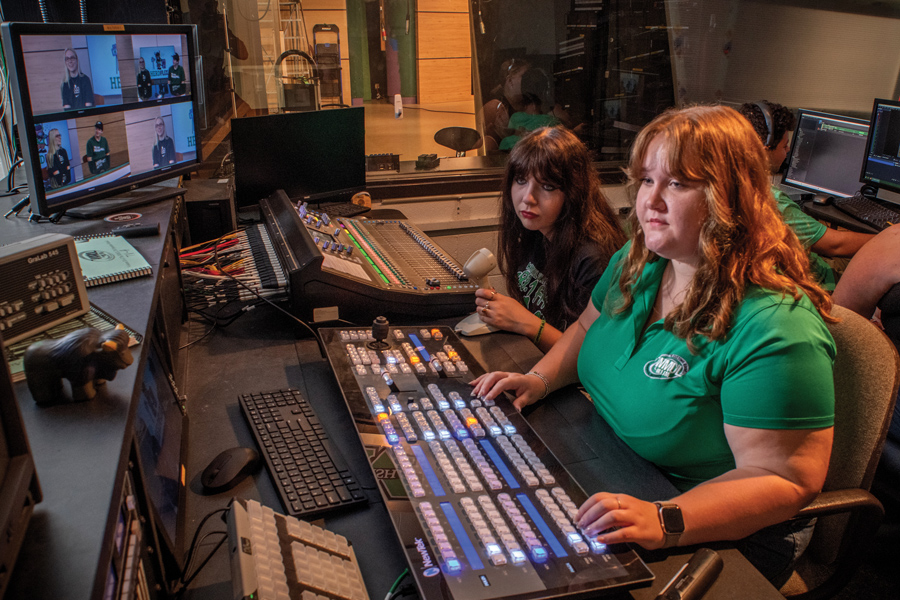
Since 2023, opportunities for students, for instance, have grown exponentially. The Dead Podcaster’s Society, The Kelly, Collective 37 and JMC Studios have joined The Parthenon and WMUL-FM as student-led media groups that produce professional content daily and collaborate with local industries.
These student organizations have afforded students the opportunity not only to win regional and local awards but also to obtain job security upon graduation.
“One of the many ways that you can measure the health of any school is what’s happening to the students when they graduate, and we are working closer than ever before with the media and with professionals,” Quicke said. “I think our students can go toe-to-toe with anyone from any program in the country.”
Many of the school’s students demonstrated their ability to do so during Student News Live, a 24-hour, nationwide broadcast on election night in 2024 co-created by Quicke and Nick Hirshon, associate professor at William Paterson University. While universities across the country — and even some across the globe — contributed segments to the newscast periodically, Marshall’s journalism students facilitated its production throughout the program’s entirety.
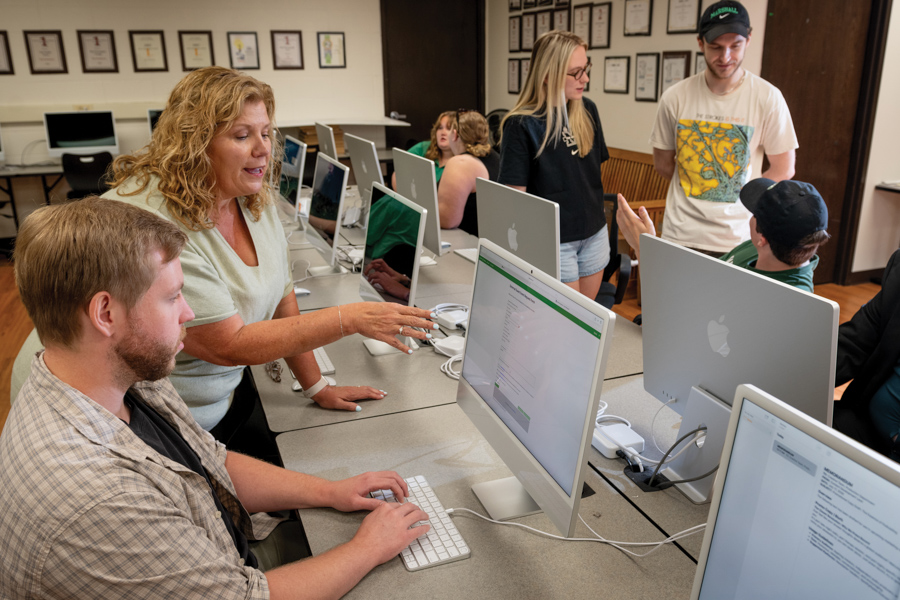
On a day-to-day basis, ensuring students’ success includes providing hands-on experience with media equipment in classes and helping secure internship experience through the school’s required program, implemented by Professor Ralph Turner during his 33-year tenure.
Above all, though, cultivating an environment where students feel seen, heard and valued is the foundation of the school’s success, Quicke said.

“Part of the process is to try and make students realize that they’re far more capable than they perhaps realize,” he said.
From Pitt to Arnold to Turner, the tradition of excellence in teaching carries on today with professors like Dan Hollis, who has won numerous regional Emmy Awards and was named “West Virginia Professor of the Year” by the Carnegie Foundation for the Advancement of Teaching in 2012.
With one-on-one support from professors and an abundance of opportunities for students to find their niche, the journalism school has developed a sense of family, which Arnold said he imagines will be highlighted at the centennial anniversary celebration later this year.
“I love being around the students,” Arnold said. “It’ll be a great, big reunion.”
That reunion is set to take place Friday, Oct. 30, in the Don Morris Room of the Memorial Student Center. The agenda includes a 100th anniversary gala and the annual Hall of Fame induction.
At the ceremony, guests will enjoy a historical look back at the last century and hear a special announcement regarding the school’s fundraising, including the grand total of the “$100,000 for 100 Years” campaign launched in November 2025. Although the campaign was to span 12 months, alumni surpassed the original goal in less than three months, Quicke said.
While new opportunities are on the horizon for the program, Quicke said the future will remain rooted in its past.
“We know who we are because we never lose sight of where we’ve been and how far we’ve come,” Quicke said.
Baylee Parsons is a freelance writer living in Huntington, West Virginia.