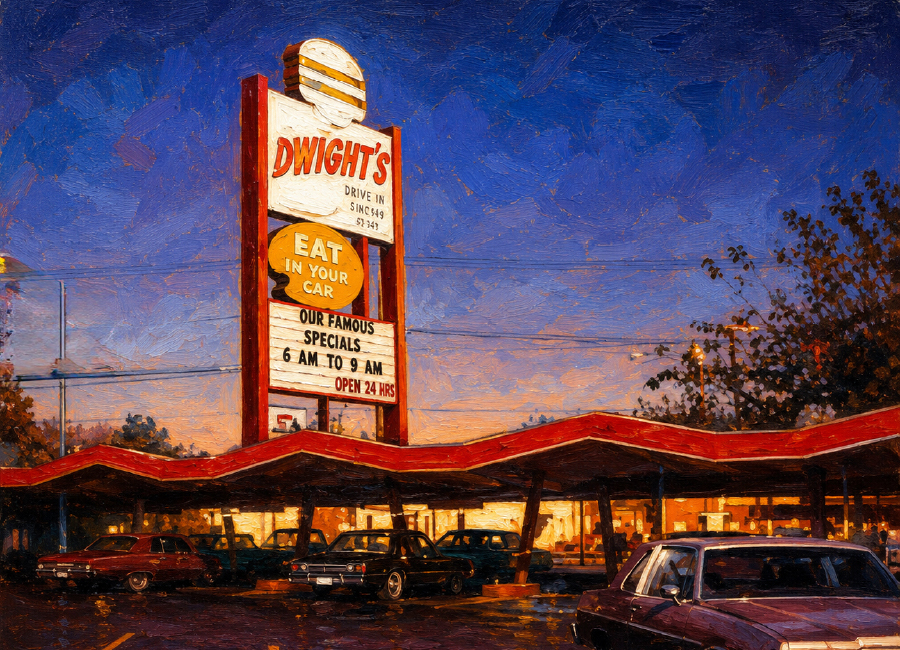
Dwight’s is a name written large in local restaurant history.
By James E. Casto
HQ 135 | AUTUMN 2026
The story of Dwight’s is rooted in a family tradition that dates back to the 1950s, when Bennie Adkins, Dwight Messinger’s father-in-law, operated several popular eateries under the name Adkins Fat Boy. In doing so, he established a legacy of hospitality and great food.
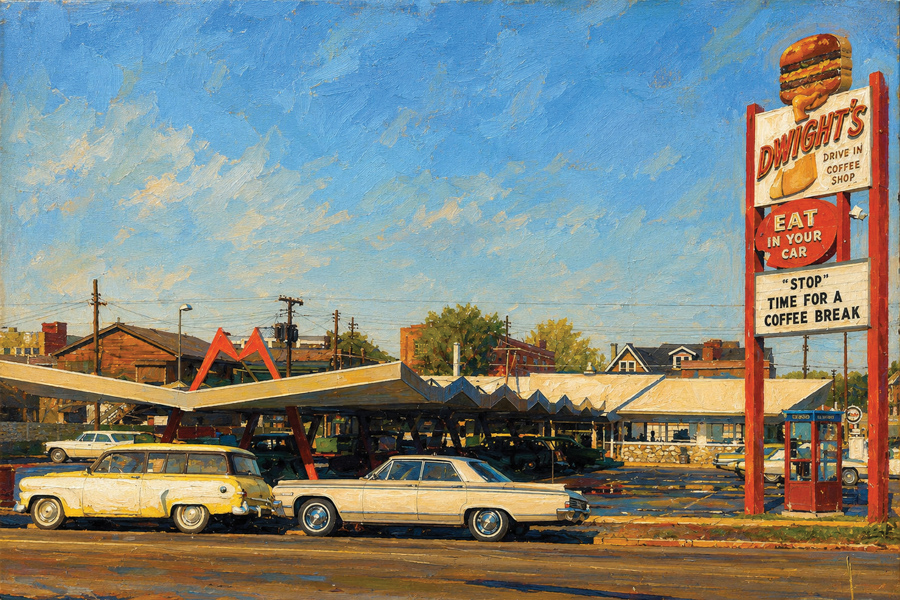
Building on that legacy, Dwight Messinger opened the first Dwight’s Restaurant in 1963. People flocked to Dwight’s for the hearty breakfasts, the Husky steak sandwiches, the strawberry pie, the hand-breaded onion rings and the coffee, which many folks swore was the best in town. It wasn’t on the menu, but another big attraction was the conversation. Morning, noon and night, friends could be found at a table or counter talking away.
Soon the Messinger family opened more Dwight’s restaurants. In Huntington, Dwight’s restaurants were located on Eighth Street, First Street, Fifth Avenue, Washington Boulevard and 20th Street, along with Dwight’s Steak ‘n’ Kettle and Alpine Village on Madison Avenue in the city’s West End.
Outside of Huntington, the Messinger family opened restaurants in Hurricane, West Virginia, and as far south as Sarasota, Florida. In the late 1990s, the family extended their business by becoming franchisees of Perkins Restaurants, opening South Carolina locations in Summerville and Charleston.
In 1993, Dwight’s youngest son, Mike Messinger, and his wife, Vickie, opened a Dwight’s Restaurant at 513 MacCorkle Ave. in St. Albans, West Virginia. Today, it’s the sole remaining Dwight’s Restaurant.
After more than 30 years, Messinger still owns and operates Dwight’s of St. Albans. Asked the secret to the restaurant’s long-running success, he cites “our tried-and-true menu.” It’s a menu that includes fresh-ground beef burgers and fat crinkle-cut fries; scratch-made soup; awesome onion rings that are cut, breaded and fried fresh daily; hand-cut steaks; and meaty spaghetti. Breakfast is served morning, noon and night, with biscuits baked daily, sausage gravy, fluffy pancakes, eggs and meats.
Another key factor in the restaurant’s success, Messinger said, is a staff “that’s like a family.” Many employees have worked at the restaurant for more than a decade — some for as long as 15 and even 30 years. But one by one, all the other Dwight’s locations closed.
Feb. 2, 1995, was a particularly sad day on Huntington’s Southside. That’s the day The Herald-Dispatch reported that Dwight’s Drive-In on Eighth Street would soon close. David Messinger, a partner in the drive-in restaurant with his father and two brothers, told the newspaper: “It was a matter of economics. Somebody wanted the property worse than we did.”
At the time, the rumor was that Dwight’s was going away to make room for a new bank, and in fact the former First Sentry Bank was soon constructed on the restaurant’s site. Many long-time Dwight’s customers couldn’t believe the popular eatery was closing. For more than 30 years they had flocked there.

Numerous Facebook users were prompted to post their feelings about the unexpected closure. Here’s a brief sampling of their comments:
The 8th Street Dwight’s was THE place to be!
In college, we went there after dancing to have pancakes in the middle of the night!
The 8th Street Dwight’s was the weekend cruising destination!
The Husky Steak and onion rings, best ever!
Dwight’s was the crossroads of America.
With the closing of the Eighth Street restaurant, some faithful patrons moved to the Dwight’s location on First Street, a 24-hour eatery operated by the Messingers. But another dark day came in 2003 when the family reluctantly decided to shut the old restaurant rather than spend the money it would take to renovate it. The building was quickly demolished. The site remains a vacant lot.
Today, Dwight’s is mostly a memory — unless you find your way to Dwight’s of St. Albans, where the welcome mat is still out.
James E. Casto is the retired associate editor of The Herald-Dispatch and the author of several books on local and regional history. He is a 1964 graduate of the W. Page Pitt School of Journalism & Mass Communications at Marshall University.