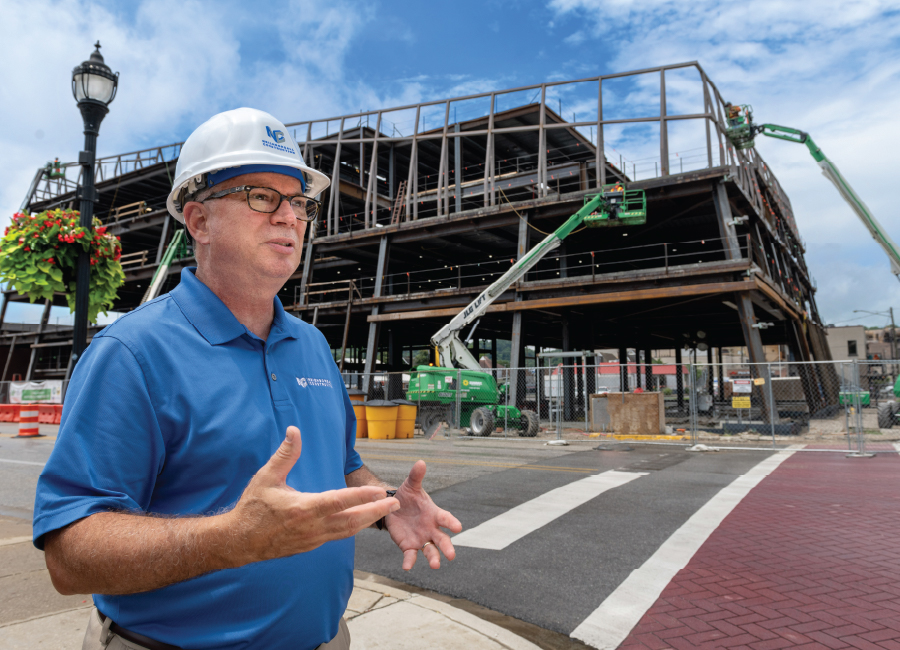
Neighborgall Construction has shaped the Huntington skyline and beyond for a century.
By Kaitlyn Fleming, photos by Rick Lee
HQ 135 | AUTUMN 2026
The story of Neighborgall Construction is written across Huntington’s skyline. From hospital wings and university buildings to the glass-fronted bank tower that catches the morning sun on Fifth Avenue, the construction company’s work has shaped the city for a century.
“We’ve been very lucky,” said Charlie Neighborgall, former president and third-generation leader of the company. “You can drive around and see your life’s work, and most of it is still there.”
Neighborgall Construction’s roots reach back to the 1920s, when Charlie’s grandfather, Charles R. Neighborgall Sr., arrived in Huntington after working in railroad procurement. After partnering with carpenter E.P. Leach on residential projects, commercial work soon followed, including the Westmoreland fire station in 1926, the year of the company’s official founding.
A century later, C.R. Neighborgall IV, current president and Charlie’s son, is building a new fire station to replace the original.
“It’s fulfilling to be building the next version of something my great-grandfather built,” he said. “This project bookends a legacy started by my family 100 years ago.”
As the company settled into its early commercial identity, World War II reshaped both Huntington and the construction industry.
“Everything was different during the war,” Charlie said. “You did whatever needed to be done.”
Under the leadership of C.R. Neighborgall Jr., the team converted the Greenbrier Resort in White Sulphur Springs into Ashford General Hospital for the War Department and built a prisoner-of-war camp at the airstrip beside the resort.
By 1946, after Leach’s sons returned from service, the original partnership with Neighborgall dissolved. Charlie’s father and grandfather then formed Neighborgall Construction, setting the foundation for the company that exists today.
Through the ’50s and ’60s, the company expanded into industrial work, often in remote areas with limited resources. Charlie said he remembers one project where the crew had to make its own concrete on site.
“If one little motor quit, we were out of business,” he said. “We had to do it all.”
In the early 1970s, the company built the glass-fronted First Huntington National Bank on Fifth Avenue, one of the most modern buildings of its time.
“It was the first project I was really proud of,” Charlie recalled. “I got to sit in board meetings with all the power in town. The building’s masonry remains uncracked to this day.”
After decades of industrial and commercial growth, the company’s story continued in hospital corridors. As Huntington’s healthcare footprint grew, Neighborgall became the contractor trusted to build around active operating rooms, emergency departments and patient floors.
“You’re building while people are being cared for inside,” C.R. noted. “You can’t disrupt that.”
Neighborgall went on to build several additions to St. Mary’s Medical Center and Cabell Huntington Hospital, projects that required extreme precision. These included the construction of the Marshall University Medical Center at Cabell Huntington Hospital, a particularly complex project.
“It was a new partnership between Marshall and Cabell,” C.R. said. “The logistics of building the structure while keeping the hospital functioning were challenging, but we made it work.”
That partnership continued with the Hoops Family Children’s Hospital, where Neighborgall helped create a space specifically designed for pediatric care.
“We solve problems and don’t give up,” C.R. said. “We also pride ourselves on keeping projects on schedule, which requires clear and timely communication with our clients to quickly resolve any issues.”
That versatility also shows up in the company’s most recent work. Neighborgall has spent the past several years renovating the 98-year-old Keith-Albee Performing Arts Center while also building Marshall’s new Institute for Cybersecurity. These two projects sit at opposite ends of the timeline — one focused on historic preservation, the other on cutting-edge technology — but both are rooted in integrity. That philosophy also guided the Marshall University Visual Arts Center project downtown, where Neighborgall reimagined a historic department store as a modern educational facility.
Whether healthcare, the arts or somewhere in between, C.R. said each project reflects a different facet of the company’s identity: adaptability, craftsmanship and a commitment to community.
Those values, Charlie echoed, are the reason the company has endured.
“Integrity and cooperation are what we’re about,” Charlie said. “We work with the owner and the architect as a team.”
C.R. agreed, saying, “That’s been the foundation forever. Responsibility, skill and integrity — all those traits have carried us through.”
The company’s workforce reflects those same passions. Several families have worked with Neighborgall for three or four generations, passing down skills the same way the Neighborgalls passed down leadership.
“We’re fortunate to have wonderful craftsmen,” C.R. said. “The work we perform is something to be proud of.”
Today, C.R. leads the company, continuing the legacy his father and grandfather built. Under his leadership, Neighborgall has taken on projects that blend history with forward momentum. Earlier this year, the company cut the ribbon on the Woody Williams Center at the Huntington Mall, located in the same building where Neighborgall once constructed Sears decades ago. The project is named for late Medal of Honor recipient Hershel “Woody” Williams.
“I think this particular project represents continuity and evolution,” said C.R. “Reaching 100 years feels like a milestone that’s both personal and communal. It’s wonderful to build things that help our community. That’s what makes it meaningful.”
A century after its founding, Neighborgall Construction remains deeply embedded in Huntington, not only through the structures it has built, but also through the values that have carried it from one generation to the next.
As the company looks ahead, C.R. said the mission is the same as it has always been: meet the community’s needs, solve the problems in front of them and leave behind quality work that endures.
Kaitlyn Fleming is a freelance writer living in Huntington. A 2026 graduate of the W. Page Pitt School of Journalism at Marshall University, she is the current director of events at Huntington Regional Chamber of Commerce.