By Vaughn Rhudy
HQ 4 | SUMMER 1990
A hot, sunny summer afternoon in Huntington’s David W. Harris Riverfront Park provides serenity, but not for long. The floating state stationed in front of the amphitheater is empty and silent now, but only for the moment. On just about any other day this time of year, the area resounds with music from a variety of bands.
It’s summertime in the park, and that means music making, picknicking, boating and tanning. It means ice cream cones stacked three scoops high, melting over the edges faster than the tongue can keep up. And it means ice cold lemonade, the kind you gulp, not sip. The Ohio River itself is busy. Jet skiers bounce over the wakes of passing power boats that cut through the currents, twisting and turning in different directions across the wide expanse.
Elsewhere in the park, visitors are walking, or picknicking, or just watching the boaters and the jet skiers. For them the park seems to offer some respite, a moment’s refuge from the everyday hustle and bustle that lie among the concrete, glass, steel and bricks on the other side of the flood wall.
Since Harris Riverfront Park was completed in the early 1980s, it has been a center of recreational activities for Huntington residents, a perfect complement to the adjacent marina and boat launch, and an important tourist attraction for the city. Now, the idea to expand the park is closer to fruition.
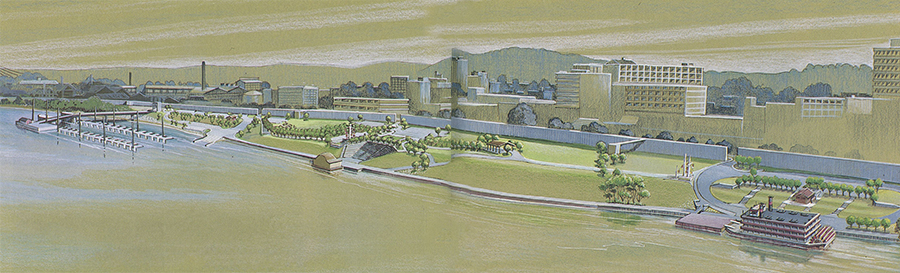
Plans call for the development of the area from the existing park, downstream for three blocks to the 6th Street Bridge. The expansion would include new access roads, a new entry through the flood wall at 8th Street, new walkways along the river’s edge and on top of the bank, new seating areas, additional restroom facilities, overlooks, landscaping, some type of kiosk complete with flags and a permanent dock for the West Virginia Belle. Additional parking areas, including pull-off spaces for tour bus parking, are part of the plan.
Recently, the House of Representatives approved $1.1 million for the proposed park expansion. The money is included in the Energy and Water Appropriations Bill, which awaits approval by the Senate. If approved there, the bill will go to conference, and then both chambers will have to pass the conference report. U.S. Rep. Nick J. Rahall, D-4th District, who requested the money for this project and another $75,000 to study flooding along Krauts
Creek in March, said he expects the bill to be approved by October.
The existing park and the area planned for expansion are on federal land controlled by the Corps of Engineers, but through a lease agreement, the city of Huntington is responsible
for the park’s upkeep. The city will have to match the amount from the federal government for the expansion. Mayor Robert elson has indicated the city will find the money somewhere, possibly through the sale of bonds.
The estimated cost of the project is $3.1 million, according to Ed Diehl, executive director of the city’s Urban Renewal Authority and Huntington’s self-proclaimed river rat.
“We’ve been working on this for approximately three years,” Diehl explained. “It still has to go through the Corps of Engineers for approval. We had to go through a master plan for improvements in the park. The master plan has been approved by the city, but we don’t know where the money is yet. We’re going to find it. We’re determined we’re going to do this project.”
Although preliminary cost estimates for the expansion are about$3 million, Ben Borda, the Corps of Engineers’ project manager for Huntington projects, said the final figure could be higher.
“We are currently getting ready to £eek approval through our channels,” Borda said. “Once approved, the next step is to come up with a certified cost estimate. We must have a cost estimate at the beginning of a project that we don’t exceed. It’s definitely a multimillion dollar project, there’s no question about that.” Regardless of the cost, everyone is sure of what the expansion will mean for Huntington.
“It’s going to increase our tourism, which is what we’re trying to do,” Diehl said. “Our city is getting geared toward tourism. It used to be the coal industry; now, it’s tourism. We’re the second largest inland port on the Ohio River, but we have a depressed coal industry. Expansion of the park will help business; it will help motels.”
Rahall said he has been talking with Mayor Nelson and city council for several years about this project. “I have always been excited about developing potential tourism for Huntington and Southern West Virginia,” the congressman said. ”We can look up and down the Ohio River at other cities that have made attractive tourist spots along the river. I want very much for Huntington to do that, and Harris Riverfront Park is one of Huntington’s shining gems.”
Rahall estimated that in one year, 309,000 people visited the riverfront park. Diehl, who oversees the park for the city, said that figure is conservative.
“The park draws about 20,000 people a day during the 10-day Summerfest activities alone,” Diehl said. “More people are coming down to the park every day. At least600,000 people come to the park in a year’s time.
“We’re trying to create recreation events for the public,” Diehl continued. ”We’re trying to create excitement for the people to come and see. I’m already involved with Summerfest, which is 10 days of excitement, with entertainment, with concessions, enticing the public to the park. What the expansion for three more blocks will really mean is that we can draw more people there and have more room for facilities.”
One of those new facilities would be a permanent dock for the West Virginia Belle, the popular excursion riverboat. Currently, when it’s in town, the Belle docks at temporary barges located in the park. Those barges sometimes affect various riverfront activities, according to Diehl.
Tim Gantz and his sister Mary, the new owners of the Belle, are excited about the possibility of a permanent Huntington home.
“We would like to have an office in Huntington,” said Tim. “It would be easier to establish a permanent office there if the waterfront project were completed.”
For several months, the Gantzes, who purchased the Belle in January from their family friend Robert Kehl, have considered establishing a Huntington office similar to the Belle’s main headquarters in South Charleston.
“We’re definitely looking at that, but right now it would be difficult,” Mary said. ”We need something more permanent than the barges. If the waterfront were complete, I’d feel more secure about putting up a permanent place of our own. We think it’s important to have a person represent us there, and one of us would be in Huntington.”
The Belle is going into its third year, providing upscale prime rib dinner cruises, dancing and sightseeing cruises along the Ohio and Kanawha rivers. For each of the past two years, 115,000 people have ridden the Belle. The Gantzes have offered some new attractions recently, including a successful teen dance cruise in Huntington. They plan an upcoming chicken and ribs night in Charleston and may schedule the same special for Huntington.
“We like to experiment with a variety of things to keep people coming,”Mary explained.
“We would like to incorporate more areas like Ashland, and we’ve already been doing a few things in Gallipolis. That would offer a variety to Huntington people as well.”
The Gantzes added that they appreciate the feelings of officials in Huntington who want the Belle to have a permanent dock.
“The people in West Virginia, particularly in Huntington, are very sincere,” Mary said. “That makes us feel good and makes our drive even stronger to perform the best we can.”
Borda, who has been with the Corps of Engineers for 18 years, said the proposed permanent dock is an important part of the expansion plan.
“We realize the Belle’s importance to stimulating the local economy,” he said. “The city has realized what a boon this riverfront has been.”
If Congress approves funding and the Corps of Engineers approves the project, Diehl believes the expansion could be completed by 1992.
However, Borda said it will take about two years to get through the engineering and design phase and then another year for construction, making the completion date in 1994.
Whenever the expansion is finished, it is clear that visitors to the David W. Harris Riverfront Park will have more room and more reasons to enjoy those lazy dog days of summer.
“I think one of the main things this park does and does quite well is it forms a connection between the river and downtown,” Borda said.” It provides a pleasant type park atmosphere for daily use.
“You can go there on any day, and you’d be surprised by the number of people jogging, walking, taking their lunch there or launching their boats. The river acts like a very powerful magnet, and it’s become increasingly recognized as the focal point for the city.”